
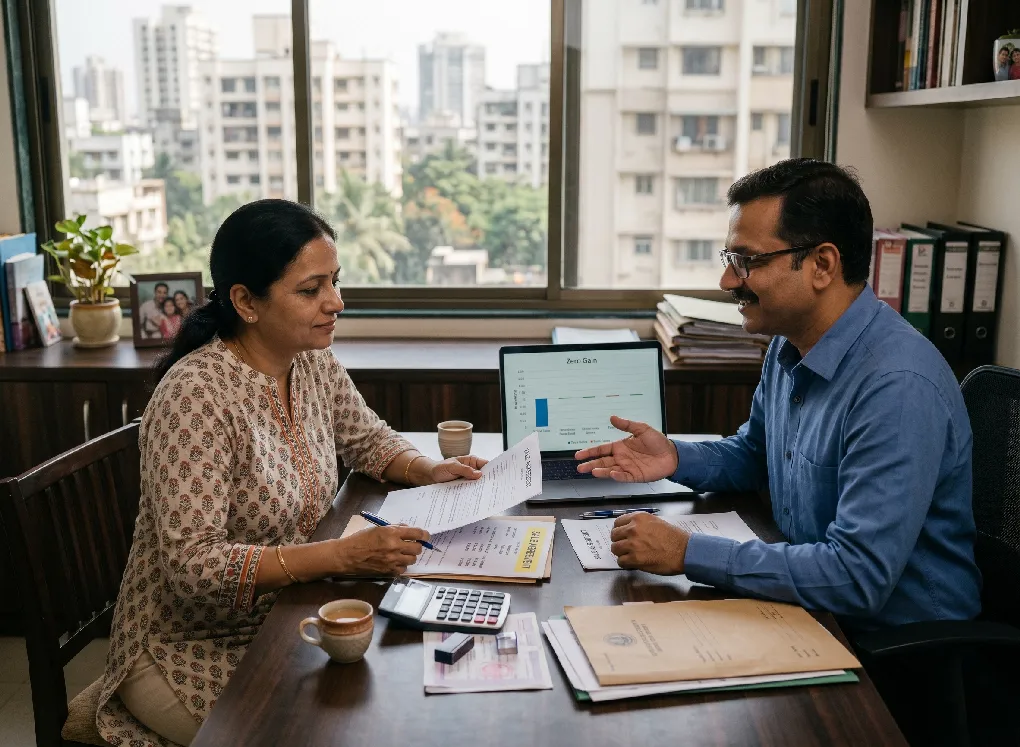
Selling a home usually raises tax issues. In India, it is common to sell the property (a home or a building) at a higher price than you bought it for, and the proceeds are referred to as “capital gains,” and the taxes paid by the government are made. However, a recent important decision by the Income Tax Appellate Tribunal (ITAT) has clarified a particular issue: what happens when you sell your property at the same price you paid for it?
It is reported that the ITAT recently held that, when the price at which an apartment is sold exceeds its original cost of purchase. The tax on capital gains is not applicable; no capital gains tax will be assessed. This decision will be a welcome relief for taxpayers in a “break-even” situation.
Understanding the Case
The matter involved a taxpayer who purchased the property with her partner for Rs 85 lakh. Two years later, the couple sold the property for the same amount – Rs85 lakh. Since ownership was split 50-50, the taxpayer’s share of the sales proceeds totaled Rs 42.5 lakh.
While conducting a routine check at the time, the Income Tax official saw Rs42.5 lakh deposited into the taxpayer’s account, but was unable to find the documents showing how much she initially paid for the transaction. Due to the absence of immediately available proof and evidence, the tax officer treated the total of Rs 42.5 lakh as a “short-term capital gain” and demanded that the taxpayer pay tax on it.
The Tribunal’s View
The taxpayer appealed the decision, arguing that although she did get Rs42.5 thousand from this sale, the judge did not take into account what was the “cost in acquisition”-the Rs42.5 thousand she spent to purchase her portion of the property in the first place. The taxpayer also claimed that the additional costs, including stamp duty, in fact led her to have technically made only a tiny loss, not income.
The ITAT assessed the facts and uncovered a crucial detail that the tax department had already approved the husband’s tax return for the identical property. In his case, the department accepted that because the purchase and sale prices were the same and there was no gain, there was consequently no tax.
A tribunal decided in favor of the woman, saying that tax is not imposed on a “gain” that doesn’t exist. They stressed that the capital gains tax is intended to tax profits, not the total amount earned from selling.
What This Means for Property Owners
This ruling is a reminder of a basic but crucial rule in the realm of taxes and property: No Profit = No Tax. To calculate capital gains, you typically follow this formula:
- sale price plus the cost of purchase, less Transfer expenses (like Stamp Duty).
If the outcome is negative or zero, then you are a loss. amount (a loss). You do not need to pay capital gains tax.
Key Takeaways for Homeowners
- Keep Your Paperwork Prepared: The only reason this case was brought to the court was that the taxpayer did not initially submit all the documents for purchase to the tax official. Keep your purchase deeds, stamp duty receipts, and registration documents safe.
- Consistency is Important: In joint ownership instances, the tax authorities must consistently treat both owners. If one person is relieved of tax because there was no gain, then the same reasoning should apply to the other.
- Short-Term vs. Long-Term: This instance involved capital gains from short-term use (property held for less than the specified period). However, the principle is similar for long-term sales. If there isn’t any actual gain in value, there is no tax to be paid.
- “Real Income” Principle: Tax experts note that this ruling abides by the concept of “real income.” The government has the right to a portion of your earnings; they can’t claim a percentage of the initial investment.
Conclusion
Many find that selling a home can be a difficult process, with financial and legal obstacles. The rules of this kind from the ITAT provide a degree of common sense within the tax system. They ensure that taxpayers aren’t unfairly penalized for converting cash from a tangible property (a flat) into cash, provided they did not realize any financial gain during the process.
If you’re planning to sell your property for the same amount you paid for it, make sure the documentation is to avoid unnecessary disagreements in tax court. Although the law is with you, making sure you have the correct documentation in the right place at the right time is the best way to guarantee an easy, tax-free exit.
Disclaimer: This article provides general information regarding tax rulings and should not be taken as professional legal or financial advice. Always consult a qualified tax expert for your specific property transactions.
Also Read: The Silicon Valley Shift: Why Bengaluru’s Real Estate Market is Facing a Reality Check
Source: ET Reality

Write Your Comment