
What is Buying Power?
Simple, purchasing power is the most you can afford to invest in a home. It is calculated by adding the savings you have (the down payment cost) to the amount an institution is willing to loan you.
If you have more money to pay down, your purchasing power grows. For example, if the bank allows you to take out a ₹300,000 loan. If you have ₹20,000 in savings, your purchasing capability is ₹220,000. However, if you have saved ₹60,000, your purchasing power increases to ₹360,000. This additional “power” allows you to consider more desirable locations, bigger homes or houses that don’t require expensive repairs.
How the Down Payment Affects Your Loan
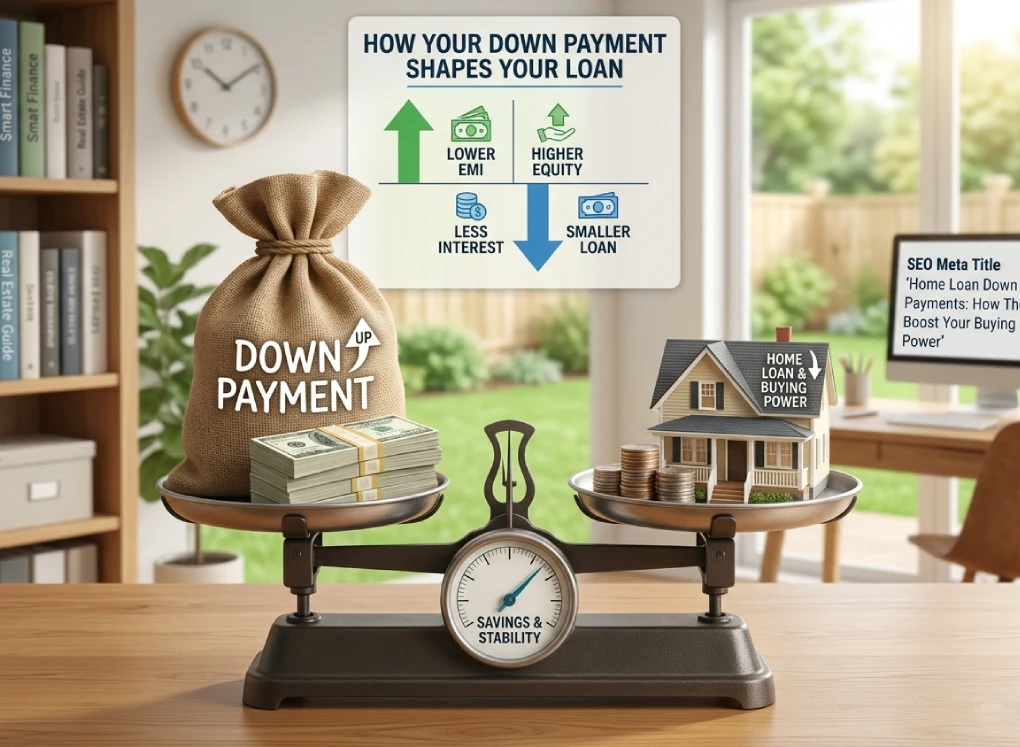
The down payment isn’t simply the term “deposit”; it changes the mathematical equations of your mortgage in a variety of ways:
1. Lower Monthly Payments
The more you pay up front and the lower your monthly payment, the less you have to take out. Because the monthly EMI (Equated Monthly Installment) is based on your total loan amount, a smaller loan amount means you pay a lower monthly cost. This gives you extra money every month to spend on food and travel, as well as home improvements.
2. Better Interest Rates
Banks consider a huge down payment as an indication of financial security. If you pay 20 percent instead of 5 percent, and the bank sees you as a “low-risk” borrower. To reward you, they could offer you a lower interest rate. For a 30- or 20-year loan, even a slight reduction in interest could save you hundreds to tens of thousands.
3. Avoiding Extra Insurance Costs
In many places where you have to pay less than 20% of your house’s value in advance, the lender will require you to purchase “mortgage insurance.” This insurance helps protect the lender if you are unable to pay; however, it will also add a substantial cost to your budget each month without providing any benefits. A higher down payment can help you avoid paying this fee completely.
Building Equity Faster
“Equity” is the portion of your home in which you are actually the owner. If you purchase a property for ₹400,000 and pay ₹80,000, you’ll have 20% ownership of the house. This provides you with a head start. If the prices of homes in your region increase and your equity increases more quickly. The advantage of having a high equity is should you ever need to sell the home or use it to finance future requirements, such as setting up a business or financing education.
The Psychology of a Strong Offer
In a crowded property market, buyers prefer buyers with a substantial down payment. This shows you’re committed to your loan and are more likely to get approved swiftly. If a seller receives two similar offers, it is almost always the case that they select the one with the higher upfront cost because it’s the “safer” deal.
Finding the Right Balance
While a big down payment can be beneficial, you shouldn’t use every penny of your savings. Still, you need an “emergency fund” for unexpected repair costs, relocation costs, and legal fees.
Tips for saving for your down payment:
- Make a Plan for the Future: Research the average cost of a home in your preferred location and try to get at least 10%-20 percent.
- Automate savings: Make a regular transfer each month into a designated “House Fund” account.
- Cut down on small expenses: Cutting back on extravagant subscriptions and dining out could add up quickly over the course of a year.
Conclusion
The down payment is at the base of your journey towards homeownership. By saving more before buying, you will be able to secure a lower interest rate, reduce the stress you face each month, and enter your dream home with greater savings. It’s not only about the home you purchase now. It’s regarding the financial freedom that you can enjoy in the future.
Short Disclaimer: This article is for informational purposes only and does not constitute financial advice. Please consult with a qualified mortgage professional or financial advisor before making any significant real estate investments.
Also Read: Tech Giant Expands: The Massive New Office Space in Bengaluru.
Source: Reality+

Write Your Comment