
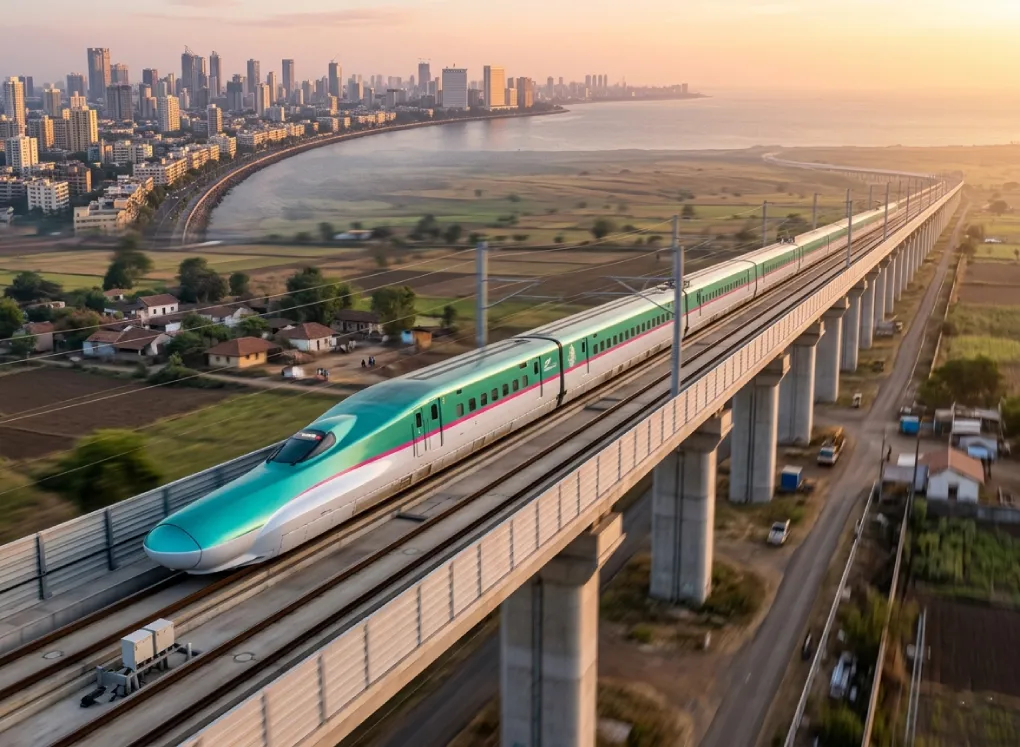
Introduction: India’s Fastest Rail Dream Is Taking Shape
For many years, high-speed rail in India seemed like an unattainable goal. However, in 2026, this Mumbai-to-Ahmedabad bullet train plan will no longer be an idea, but a fast-becoming reality.
There is visible construction in key locations such as the Bandra-Kurla Complex (BKC), Thane, and parts of Gujarat. This massive infrastructure project is expected to change the way people travel between these two important economic centers.
When operational, the bullet train is expected to cut travel time by 6-8 hours to 2 hours and will mark a major change in the Indian transportation system.
Project Overview: Speed, Route, and Key Highlights
The Mumbai-Ahmedabad High-Speed Rail (MAHSR) corridor is India’s first bullet train, inspired by the Japanese Shinkansen.
Key Highlights:
- Total Distance: Approx. 508 km
- Top Speed: Up to 320 km/h
- The Travel time: Around 2-3 hours
- Twelve major stations comprising Mumbai, Thane, Vapi, Surat, Vadodara, and Ahmedabad
This project aims to provide a faster, more efficient alternative to air travel, particularly for commuters who work or have frequent travel needs.
The Engineering Breakthrough: India’s First Undersea Tunnel
A major technological aspect of this development is an undersea tunnel near Thane Creek.
Key Details:
- Tunnel Length: ~21 km
- Underwater Section: ~7 km
- Depth: Around 30+ meters below ground
Large tunnel boring machines (TBMs) are being used to cut through rock and soil. This marks an important achievement in India’s engineering skills.
Why It Matters:
- Protects sensitive ecosystems from disturbances, such as mangroves and the habitat of flamingos
- Shows India’s ability to carry out complicated infrastructure projects
- Lays the stage for the future expansion of high-speed rail
Transforming Regional Connectivity and Daily Commutes
The most significant consequence of the bullet train’s construction will not be just speed but connection.
Key Benefits:
- The journey from Mumbai to Vapi takes less than 1 hour.
- Greater connections between hubs of business
- Reduction in dependency on airlines for travel on short distances
Professionals, that means:
- More productive travel
- Business trips on the same day
- A better work-life balance
Real Estate Boom Along the Bullet Train Corridor
The infrastructure projects of this magnitude usually trigger massive property growth. This project isn’t an exception.
Emerging Hotspots:
- Vapi
- Boisar
- Surat
- Anand
Why Prices Are Rising:
- Better connectivity to Mumbai
- Demand for commercial and residential properties
- The development of “station cities” around bullet train hubs
Investor Insight:
Properties located near high-speed rail stations usually appreciate over the long term, making this an investment zone.
“Make in India” Push: Boost to Local Manufacturing
Although the initial project relied on Japanese expertise, India is increasingly contributing to its execution.
Key Developments:
- Indian companies such as BEML Limited are involved in manufacturing
- The production of train components is a local process.
- Skill development in high-speed rail technology
Economic Impact:
- The creation of jobs across different sectors
- The strengthening of manufacturing in the country
- Lower long-term dependence on imports.
The Last-Mile Connectivity Challenge
Although the bullet train promises speed, its performance is contingent heavily on the last mile of connectivity.
Current Concerns:
- Congestion in traffic near stations
- A limited integration with local transportation systems.
- Delays in urban infrastructure development
Planned Solutions:
- Hubs for integrated transport (metro + railway + roads)
- Smart station for city planning
- Better urban mobility systems
Without reliable last-mile connectivity, the efficiency of high-speed rail may be diminished.
Cost and Ticket Pricing: Will It Be Affordable?
One of the topics that has been debated most throughout the project is the ticket price.
Expected Range:
- Estimated price: Rs3,000 to Rs4,000 per journey
Comparison:
- Similar to last-minute flights
- More convenient due to:
- No long wait times at the airport
- City-center to city-center transportation
Value Proposition:
For many, the bullet train is a great option. It offers an ideal balance of speed, comfort, and convenience.
Safety and Technology: Inspired by Japan’s Shinkansen
Mumbai-Ahmedabad’s bullet train is inspired by Japan’s internationally renowned Shinkansen system.
Safety Features:
- Zero mortality record for Japan
- Earthquake detection systems
- Automated braking mechanisms
This ensures world-class security for Indian passengers.
Timeline: When Will the Bullet Train Start?
Current Progress:
- Gujarat section nearing completion
- Maharashtra section progressing steadily
Expected Timeline:
- Partial operations: Around 2027
- The corridor will be fully completed in 2029.
Although delays have been reported, progress in construction indicates that construction is moving forward at a strong pace toward finalization.
Impact on Existing Rail and Transport Systems
The bullet train isn’t intended to replace existing rail systems, but to supplement them.
Benefits:
- Lower pressure on rail routes
- Greater capacities for local trains
- Increased overall efficiency of transport
This will greatly improve the daily commute, particularly in dense areas such as Mumbai.
Frequently Asked Questions
In most cases, yes, particularly when it comes to airport waiting time and security checkpoints.
Initiatives such as underground tunnels and route design are designed to reduce environmental impacts.
Busy commuters, business travelers, and real estate investors on the highway.
While the price may be higher than that of normal trains, it’s expected to be competitive with air travel.
Final Thoughts: A Turning Point for India’s Infrastructure
The train that runs from Mumbai to Ahmedabad does more than transport passengers. It marks a change in how large-scale infrastructure projects approach India.
By drastically reducing travel time while improving connectivity and driving economic growth, it can transform both mobility and the real estate market.
Although challenges such as last-mile connectivity and project timelines persist, what has been achieved so far indicates a clear dedication to modernization.
As India advances towards faster, more efficient transport systems, this high-speed rail corridor may serve as a blueprint for future projects across the nation.

Write Your Comment