Bengaluru, known as”the Silicon Valley of India, is a city always in motion. But for those living in the city, “moving” often involves dealing with some of the most difficult traffic. This is why the development of the “Namma Metro” network is more than a mere public transportation project; it’s an immense economic engine.
Recent reports suggest that the upcoming metro lines, especially the Yellow and Pink Lines, will fundamentally alter the city’s real estate landscape. From rising housing costs to a spike in demand for office space, the “metro effect” is real and growing rapidly.
The Rise of Office Demand
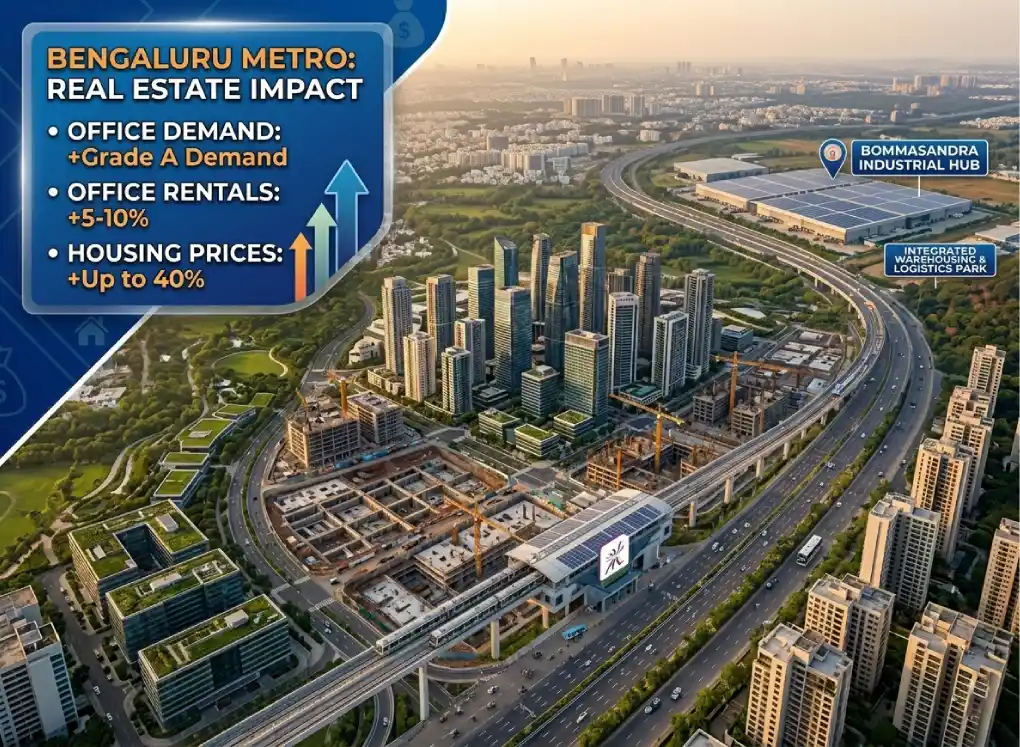
The expansion of the Bengaluru metro corridors is anticipated to drive a major increase in demand for premium office space. According to experts’ estimates, another 5 to 7 million square feet of “Grade A” (premium) office space is expected to be required over the next two years.
Large business zones such as Electronic City and the Central Business District (CBD) are likely to attract the most attention. As travel times decrease, businesses are more likely to establish offices in these regions. It is expected that by 2027, office centers aligned with these new trends will make up more than 20 percent of the city’s high-end office inventory. For companies, this means greater access to talent, and for landlords, it’s increased earnings, as office rentals are anticipated to increase by 5 to 10 percent in the near term.
Housing Prices on the Fast Track
If you’re looking to purchase a house near the newly constructed metro lines, act swiftly. The fully operational Yellow Line, which connects to South Bengaluru, has already had a major impact. In areas such as Electronic City, housing prices have increased by almost 45 percent.
The forthcoming Pink Line, which will run through Kalena Agrahara up to Nagawara, has created equal excitement. Neighborhoods such as Bannerghatta Road and JP Nagar are witnessing a resurgence in interest, particularly for middle-income and luxury homes. In the end, experts believe that the value of homes in important micro-markets in these corridors could climb by up to 40% over the coming years.
Many people find the ease of not having to travel through Bengaluru’s notorious traffic is worth the price. It doesn’t just reduce time; it also improves the quality of life and makes these catchments for residential use extremely desirable.
Beyond Offices and Homes: Warehousing and Industry
The metro doesn’t only serve office workers. It’s aiding the manufacturing and logistics industries. Its Yellow Line has improved access to industrial hubs, such as Bommasandra, Jigani, and Attibele. This allows workers to travel to their workplaces and aids the flow of products.
With this enhanced connectivity, it is expected that there will be demand for anywhere from 1 to 2 million square feet of warehouse and industrial space. This could increase warehouse costs by 5% to 8%. As e-commerce and “quick commerce” (fast delivery services) continue to expand, having distribution centers near accessible transit lines is becoming increasingly important.
Mapping the Future: Yellow, Pink, and Blue
The metro doesn’t only serve office workers. It’s aiding the manufacturing and logistics industries. Its Yellow Line has improved access to industrial hubs, such as Bommasandra, Jigani, and Attibele. This allows workers to travel to their workplaces and aids the flow of products.
With this enhanced connectivity, it is expected that there will be demand for anywhere from 1 to 2 million square feet of warehouse and industrial space. This could increase warehouse costs by 5% to 8%. As e-commerce and “quick commerce” (fast delivery services) continue to expand, having distribution centers near accessible transit lines is becoming increasingly important.
The Big Picture
The growth of the Bengaluru metro corridor will go beyond simply providing a ride; it’s making “growth centers.” We are witnessing an increase in hybrid work models, with companies having their main offices in the city centre and smaller “satellite” offices in residential areas near metro stations.
For investors, the message is simple: infrastructure creates value. Residents, too. The goal is that a better-connected city will eventually result in less time spent on the roads and more time at home. Although the increase in property costs could be a problem for individuals, the benefits of a reliable, robust transportation system are likely to keep Bengaluru’s real estate sector among the top in the country.
The city is continuing to grow both upwards and outward; the metro is the main link that holds the entire thing together.
Disclaimer: This article is for informational purposes only. Real estate market trends are subject to various economic factors, and readers should conduct their own research before making investment decisions.
Also Read: Shaping the Future: The Rise of Mumbai 3.0 in Raigad.
Source: Hindustan Times


Write Your Comment