
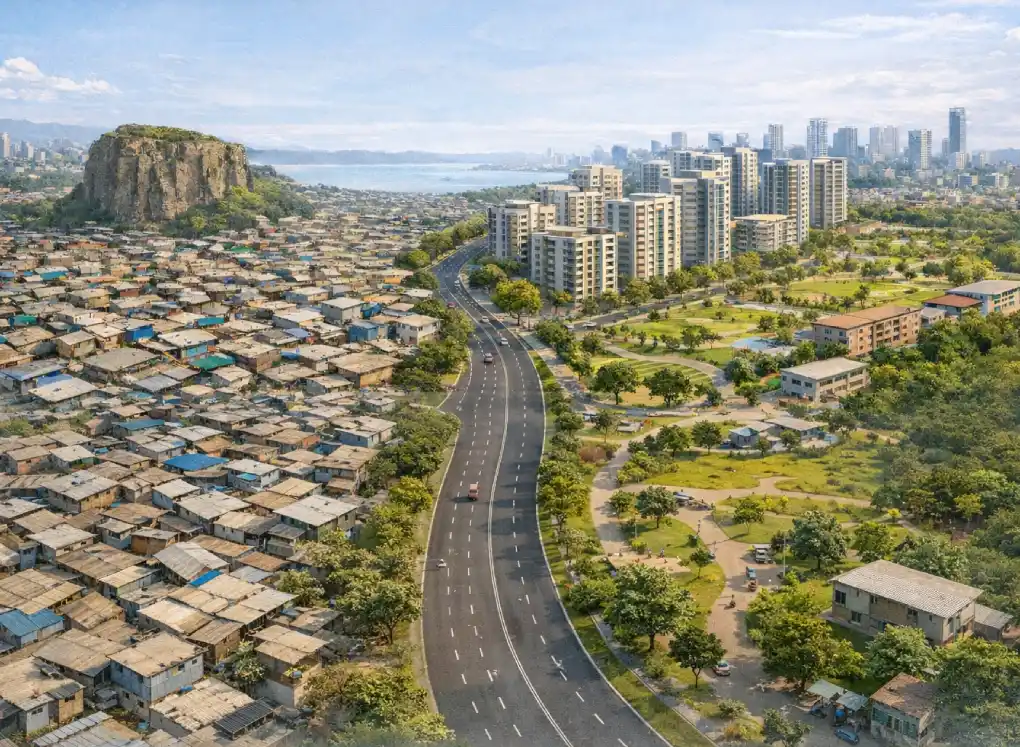
Mumbai’s Bold Step: Transforming 19 Major Slum Clusters for a Better Future

Mumbai’s Bold Step: Transforming 19 Major Slum Clusters for a Better Future
Mumbai, the dream city, is renowned for its tall skyscrapers and its lively, bustling streets. But it’s also an area where a substantial percentage of people live in the slums of Mumbai. The issue for a long time was providing residents with better housing and making the city more efficient. Recently, a breakthrough was announced that could transform the way the city is viewed forever.
The Maharashtra government, via Slum Rehabilitation Authority (SRA), is a department of the Maharashtra government. Slum Rehabilitation Authority (SRA) has announced an ambitious plan to revitalize 19 major slum areas across Mumbai. This isn’t a minor fix. It is a major plan to transform slums into more modern communities with better infrastructure.

What is the New Redevelopment Scheme?

The idea behind this strategy is to bring together different slum areas into “clusters.” In the past, redevelopment occurred in isolated, small patches, often resulting in uneven expansion. In this new plan, the government is focusing on large parcels of land that cover at least 50 acres.
For a plot to be eligible, it must be a good fit; at least half of the area (51 percent or more) must be slum areas. If you look at these vast areas in their entirety, the government can design improved roads, better water infrastructure, and parks, rather than simply constructing several apartment blocks in an uninviting space.

Key Areas Targeted

One of the more renowned locations of this project is a 100-acre parcel located in Andheri West, near the famed Gilbert Hill. The area contains more than 14,000 tiny huts and several older structures. By removing this large area and rehabilitating it, cities can provide thousands of families with the opportunity to live healthier lives.

However, the plan doesn’t end at Andheri. SRA has identified 18 other locations. SRA have identified 18 additional places, including:

  • Mankhurd and Govandi
  • Sion and Wadala
  • Vikhroli, Goregaon, and Kandivli
  • Borivli East

They are among the most densely populated areas of Mumbai and their development could drastically reduce the city’s housing crisis.

A Modern Approach to Urban Living

The principal purpose of this initiative is “integrated and sustainable planning.” Simply put, this involves creating a mini-city within the city. Instead of simply changing huts into buildings, the idea is:

  • Scientific Planning: Layouting the design to ensure effective garbage collection, drainage, and power.
  • Civic Facilities, ensuring there’s the space needed for clinics, schools, and playgrounds.
  • The Quality of Life is creating an atmosphere that allows residents to breathe more space and cleaner sanitation.

The SRA is the principal agency responsible for ensuring each step, from checking land boundaries to hiring builders.

How Will It Be Built?

As these projects are large, the government is employing various methods to complete them. In certain cases, the government agency can do the job. In other instances, they could work with private builders in bidding processes (tenders).
In addition, when a private landowner controls a large part of the group, they could take over the development. If they own private property within these clusters, the government offers an equitable deal. They can either get a developed piece comparable elsewhere or receive compensation. If the owners aren’t happy with the government, the government can acquire the land to ensure the public project can proceed.

Inclusion and Progress

One of the most distinctive aspects of this plan is that it covers difficult areas, such as coastal land (Coastal Regulated Zones). It also permits the inclusion of deteriorating structures and vacant land that were previously considered too difficult to construct on. Even land owned by the central government could be included in the plan, provided the central government consents.
This comprehensive approach ensures there are no “dead spots” in the middle of a newly developed cluster. It makes for a smooth, modern, contemporary neighborhood.

The Road Ahead

Although the plan is complete, there’s still work to do. A high-powered committee, headed by top housing officials, will be in charge of the approvals. When the boundaries of each plot have been determined, the government will begin inviting builders to build.
For the tens of millions who live in the slums of Mumbai, this plan is a sign of hope. It’s a step away from temporary fixes toward the long-term solution. With a focus on large groups and smart planning, Mumbai is taking an enormous leap towards becoming a top-quality city, with every citizen having adequate housing.

Disclaimer: This article provides general information regarding Mumbai’s urban redevelopment policies based on recent reports. Readers should verify specific project details and legal provisions with official government sources. (29 words)

Also Read: New Horizons: The Massive Plan to Rebuild Dharavi Starts with Railway Land.

Source: ET Reality  

    ✅ I agree to be contacted by Behind The Bricks Team via WhatsApp, SMS, phone, email etc.

    .

    Leave a Reply

    Your email address will not be published. Required fields are marked *

    Index